



Have you ever thought about praising God as a response to a negative situation?
Responses are important. If we’re in an accident, we want a quick response from emergency workers to come to our rescue. If our children are hurt, sick, or need something basic like a diaper change, our desire as a loving mom is to respond to their needs as quickly as possible.
We respond to other things, too. Disappointing things happen, and we respond. Bad news pops up…and we respond. People hurt us…and we respond. The question of the day then becomes, HOW do we respond?
Think about your recent situations and the words that popped out of your mouth or the expressions that crossed your face. I can think of people I’ve been around lately and hear their voices. They sound like: “Well, crap.” “OH MY GOSH!” “You’ve got to be kidding me.” “I’m going to kill that…” “Wait until I get hold of them.” “WTH!” (These are the tame, semi-curse-free response examples.)
If Proverbs teaches us anything, it’s about the power of our voices, verbalized or not.
Proverbs 27:19
As water reflects the face,
so one’s life reflects the heart.
Leah, A Rejected Young Woman of the Bible.
Leah. You may have heard of her, but probably not positively. She’s a woman rarely taught about in churches and never mentioned during “greatest women in scripture” messages.
Her story is first found in Genesis 29, the oldest daughter of a man named Laban. Her main physical attribute is described as being “weak eyes”. She was not a beauty and was not highly sought after as a bride. As her story unfolds, her only hope of being married was through deception – at least, that’s how her dad saw the situation. She’s not exactly someone we ascribe to be like, hence history’s avoidance of Leah and choice to focus instead on her beautiful, younger sister, Rachel.
Leah was the firstborn tagalong, always coming in second to her gorgeous, younger sister, the shepherdess Rachel. Rachel was the one who caught the eye of Jacob (Abraham’s grandson) immediately, her beauty was so alluring. She had beauty and brawn (she was the one who watered the sheep – it takes some muscles to pull the water up from the well!). She was the adored one.
Jacob was willing to work seven years to win Rachel’s hand in marriage. It was after these seven long years of waiting for his beautiful bride that Jacob was tricked instead into marrying Leah. What a horrible position for Leah to be in! It’s a story worthy of a Housewives of Canaan episode. Deception spiraled into anger, jealousy, heartache, revenge, and then bled over into the next generation with attempted murder, kidnapping, hatred, and abundant lies.

Why Leah in the Bible Matters: Her Kingdom Legacy
Just as Leah wasn’t an external beauty, God spoke generations later about her descendant, who was about to be anointed king of Israel, who also wasn’t a man of external beauty and was overlooked by his father, “I don’t look upon the outer appearance but I look upon the heart.” (1 Samuel 16:7) or an even further descendant prophesied as, “He had no beauty or majesty to attract us to him, nothing in his appearance that we should desire him.” (Isaiah 53:2b)
That’s right, Leah was the one who King David and JESUS both descended from, not Rachel. Jesus was in the lineage of Leah! Let that sink in for a moment. Jesus had many women in his lineage. It wasn’t the most beautiful who were chosen. It was the pure of heart. The repentant. The obedient. Women like Rahab and Ruth. Women with tainted pasts who were willing to lay it all down and honor Adonai.
Like Leah! Leah honored Adonai. Leah loved Adonai, and Adonai loved Leah and honored her with marriage when no man would choose her. Adonai honored Leah with children. She wasn’t just honored with children, but honored with a legacy.
Why?
A Young Biblical Mother’s Response to Disappointment…
Leah’s desire for love is evident as she names her sons. At first, we see she is working hard to earn her husband’s love. Of her firstborn, Reuben, she said, “It is because God has seen my misery! Surely my husband will love me now.” With her second born, Simeon, she said, “God has heard that I am not loved. He gave me this one, too.” Her third child, Levi, reveals her deep heart’s desire for her husband to love her. With Levi’s naming, she said, “Now at last my husband will become attached to me because I have borne him three sons.”
Unfortunately, he didn’t.
Up to this point, Leah’s hope was for her husband to love her. She recognized God’s favor upon her, giving her sons, but her focus was on finding favor with her husband.
By her 4th son, Judah, Leah releases her grip on Jacob and focuses her eyes on Adonai, her Maker. With Judah’s naming, she declares, “This time I will praise Adonai!” Why? She had walked through some difficult times of deception, rejection, hurt, and pain. At this point, she chooses to take her eyes off herself and put them on the Lord. She begins to praise God amid her painful situation. Jacob ceased to be her heart’s desire, and God became her desire.
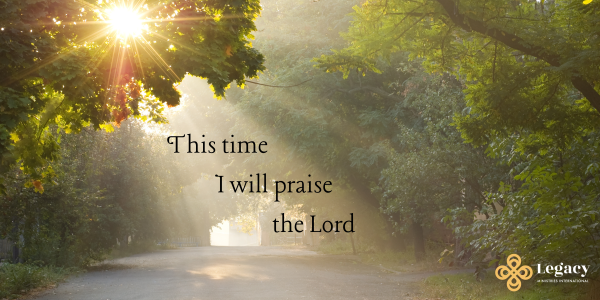
Leah’s Turning Point: Choosing Praise Over Pain
I’ve often wondered, why Judah? Judah wasn’t the firstborn, and he was a jerk as far as being a human goes. So why was Judah chosen to be the name of the Royal lineage of Christ? I believe it goes back to Leah. A faithful woman who declared praise over her child, she honored the heart of God so deeply in the middle of her dire situation that Judah was chosen to be the forefather of Jesus. Not because of anything Judah did – but because of Leah’s powerful praise.
Leah could never have known what the future held when she chose to praise God over her pain, just as we don’t know in our moments what will happen when we choose to honor God in the pain.
- When we praise God in the horror.
- When we praise God in the hurt and pain.
- When we praise God in grief and disappointment.
- When we praise God in sickness.
It’s easy to praise God in the good times or when we are surrounded by beauty. It’s not natural to praise God in the difficult, which is why it becomes a posturing of the heart the pulls on the supernatural power of heaven.
Rachel had what the world seeks after (then and now). Often, beauty is only skin deep, as it turns out with Rachel. Rachel was also jealous, deceptive, and a thief. She worshipped her father’s idols rather than Adonai. There were consequences to her life choices: barrenness and early death.
Proverbs tells us that the path to long life comes from wisdom, righteousness, and the fear of the Lord. (Proverbs 3:16-17, 10:27, 16:31) Rachel’s life proves this true. God did honor her and Jacob’s love for her through Joseph and Benjamin, from which the tribes of Ephraim, Manasseh, and Benjamin came into existence. However, her life was cut short not long after the birth of her 2nd son. She missed out on so many blessings because of her life choices. Beauty will only take us so far. There must be greater depth to the children of God.
Instead, praise God!
When we praise God during unspeakable pain… When we praise God amid betrayal and rejection… When we choose not to gossip, mope, be filled with fear, curse, grumble, and complain but instead praise God, the heavenlies shake! This is a turning away from natural feeling, from carnal responses – the choice to praise God anyway breaks chains and sets captives free. It releases power from on high. Dunamis explosive power! Kingdoms shift. Dry bones come back to life. Spiritual dryness is broken off, and wells of revival begin to rise.
Leah-like Faith Paves the Way for Royal Lineages.
Leah’s name means “strength, endurance, and resilience.” Leah was the ultimate warrior-princess-overcomer. I pray for a generation of Leahs to rise up. Let’s stop chasing after the temporal, external beauty that covers over internal decay.
Instead, Women of God, repent and arise. You are born for more than temporal carnality. Step into your royal lineage! Become a praiser that brings explosive power to earth and expands the Kingdom of God.
What does this kind of praise look like?
- It looks like two children leading a praise festival at their father’s funeral.
- It looks like a cabin of children praising God as the waters rise to drown them. (See this blog for the full story: 6 Degrees of Separation: How to Pray When Tragedy Feels Far Away—But Isn’t)
- It looks like laughter in the face of a grim diagnosis.
- It looks like speaking the names of Jesus over your mind when you’ve been through the unspeakable.
- It looks like worshipping God when your car breaks down in the middle of nowhere and seeing his miraculous provision to get you out.
I know the stories behind each of those examples – and they are amazing and faith-building! What has it looked like for you? What will it look like the next time? Be a Leah – and teach your daughters to be Leahs too. Praise God even when life doesn’t look the way you hope and expect – and step into your royal destiny!
Proverbs 27:21
The crucible for silver and the furnace for gold,
but people are tested by their praise.
By Amy Sun








So good!!